Alas, a Second Pearl Harbor
How to be splendidly political, Nagasaki style, and some thoughts about the purpose of historical memory

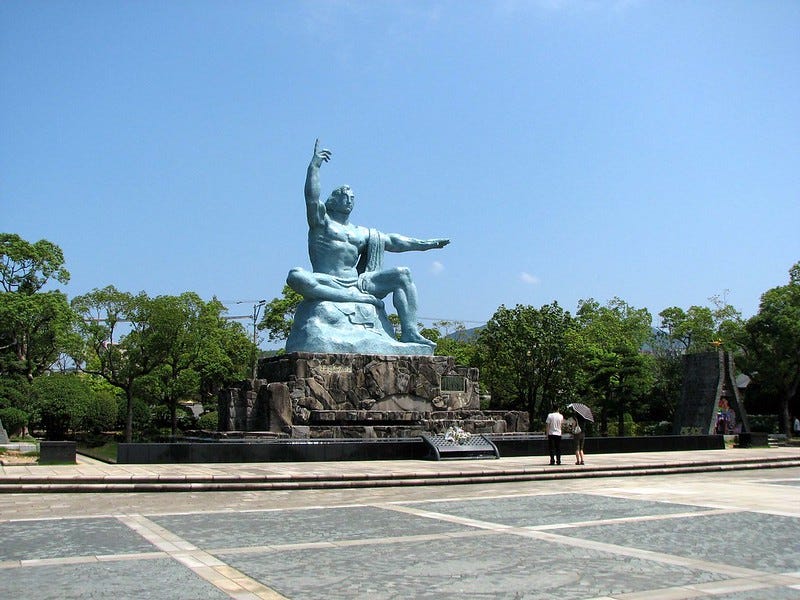
I think that the decision by Shiro Suzuki, Nagasaki’s mayor, to disinvite Israel from the city’s yearly commemoration ceremony, a decision that caused multiple Western countries to boycott the event, is quite extraordinary. So much so, in fact, that may even become a historic milestone. Here’s why.
Shiro Suzuki’s decision to ask Israel's ambassador to not attend the ceremony is not only important because of the internationalization of Israel's genocide, which is happening despite huge efforts at containment made by Western countries. It is significant because Japan rarely disobeys the US, or risks arousing its anger. There are over 50,000 American soldiers stationed in Japan at all times, and one could argue safely that Japan still remains under post-WW2 occupation, much like Germany (which is home to some 35,000 American soldiers).
This decision by Shiro Suzuki is so important because it is so political, in the best and most precise meaning of the term. First, because it recognizes and addresses the present moment, and real-time is always radical (compare this to the ICJ's and ICC's sluggishness). Second, addresses the political moment in a very public and open way (compare this to anonymous reports about certain countries being displeased with Israel). And, third, it brings attention to an occurring injustice while demonstrating unwillingness to continue a ritualistic facade, and one so prestigious and celebratory.
Real-time, open and no business as usual gives Shiro Suzuki a very high political score. And this politicalness, so absent from Western cultures, is why Western powers were so taken aback by this decision: how does an Asian even imagine defying the will of great white overlords? What's next? Uncooperative Arabs? Pakistanis with an attitude problem? Africans who insist they own their own resources?
Heaven forbid. We can't have that.
-
Earlier this year we were exhilarated to hear Malaysia's PM Anwar Ibrahim admonish Germany's Olaf Scholtz about Western double standards (demonstrated by only caring so deeply for Ukraine, but never for Palestine):
And we still remember former Irish PM Leo Varadkar's comments to Biden's face about the deep connection between the Irish and the Palestinian peoples:
This, I think, is the light in which we need to see Shiro Suzuki's decision: as a moral stand against the West's deep corruption - and waning hegemony.
-
Another interesting dimension of Shiro Suzuki’s disinviting Israel’s ambassador can be found in Japan’s tough place, in terms of historical memory, as a former Nazi Germany partner in war and brutal Asian colonizer, and a longtime loyal servant of US imperial needs in the Asia-Pacific region. Showing commendable (and terribly rare) clarity and resolve, Shiro Suzuki takes a stand and signals that some things in life are more important than Western approval. This is both refreshing and a gentle, yet powerful, form of decolonization.
Epilogue: nothing is ever about the past
Since we’ve already mentioned WW2 and a commemoration ceremony, I’ll take the chance to share some of my philosophy about ‘remembering history‘, probably the single most sacred ritual and occupation of every oppressive ideology under the sun.
for example, if you look at the Nagasaki ceremony as being about history, you will miss its entire meaning (I mean the normal and standard ceremony, not this year’s disruptive one). But you will only miss it intellectually: emotionally, we seldom miss anything.
But if you disregard completely the artificial and misleading historical part of it, you will start asking meaningful questions. Something along the lines of: why are the incinerated victims of America’s atom bomb being remembered in a ceremony attended by the American government? What are we to learn from American presence in this ceremony? They are never expressing their regret and sorrow over using atomic bombs against Japan, right? So why are they there? To express that they’re not sorry? And if the Japanese are having a ceremony commemorating the incinerated victims of American Atomic bombs and it is formally attended by unregretful American representatives, isn’t the actual meaning of this ceremony the continued subjugation and humiliation of Japan?
Ideologies and establishments do not care about any one of us being familiar with the past, and besides, as a matter of principle, the past does not exist, only our intellectualization and imagining of it. If we assume even one detail wrong while trying to learn history or learn from it, if we fill any gap with any bias, then our understanding becomes a travesty. Can we seriously claim we can think about anything with complete objectivity? Every gaze into the past is doomed to be contaminated by every sort of human flaw imaginable.
But ideological establishments don’t even presume to just educate you about history: they are all about manufacturing a desired consciousness, namely one that serves best the aspirations of said establishment.
You want people to admire militaries and wars not because you want them to be great historians. It’s because you want them to have excess deference toward the military in the present day so that you’re free to use the armed forces freely to carry out your political vision.
And you shroud military history in great emotional ceremonies not because you respect the dead so much, but because you want people to unconsciously desire to be part of this phenomenon (with this I’m mind, we see Shiro Suzuki’s decision in an even more radical way: by making it openly political and about today, he breaks the fake spell created by the American treatment of WW2, a spell meant to cement America’s hegemony, but also to serve its desire for more war - like the one it produces and protects in Gaza).
Nothing is ever about the past. When anyone, a spouse, a friend, and certainly a politician talks about the past, they are always trying to blur your vision and judgment about something political (meaning: pertaining to power relations) in the present moment. In plain English, they’re taking you for a ride.


As an American, I didn't know American officials would be invited to a commemoration of Nagasaki, and if I did would have assumed that if they were they would have to at least pretend to regret that the USA nuked the city.
Thank you for this. Neo-colonialist attitudes are gross.